Drift Stack™
Defines the architectural structure, identity, frame, boundaries, state, drift, correction, and authority relationships that must remain coherent.
Mechanisms · Evidence · Execution Authority · Correction
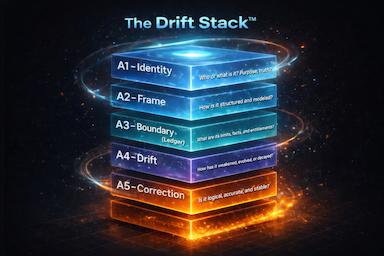
The Drift Stack™
Identity → Frame → Boundary → Drift → Correction
Recommended Architecture Path
This page evaluates whether a system actually conforms to the architecture rather than merely claiming alignment or governance.
This sequence is cumulative. Each layer builds on the one before it.
From architecture to proof
The public architecture, execution contract, admissibility gate, conformance model, certification path, and licensing terms serve different functions. None substitutes for the others.
Defines the architectural structure, identity, frame, boundaries, state, drift, correction, and authority relationships that must remain coherent.
Defines the common envelope binding proposal, identity, authority, evidence, current state, policy, constraints, admissibility, grants, receipts, and correction.
Makes the pre-execution decision and prevents a consequential action from acquiring authority merely because a model proposed it.
Proves that the implementation actually assembles, validates, constrains, executes, records, and corrects according to the governing architecture.
Authorize approved claims, implementation scope, commercial usage, and the right to represent a reviewed system or practitioner as conformant.
A standard can describe the required behavior. Conformance must prove that the behavior exists and cannot be bypassed.
Why independent assurance matters
I was offered a three-month free trial of Notion, so I decided to give it a try using my Google account.
As I went through the setup process, I was presented with Notion Calendar and the option to download its software and potentially connect it to my calendar.
Then I saw this:
“Your AI workspace with built-in agents.”
And I stopped.
I had not downloaded the software. I had not connected my calendar. I was simply looking at what I was being invited to install.
I am not suggesting that Notion's system is unsafe, that its agents are uncontrolled, or that its architecture lacks safeguards. I had not examined the system, and I did not know what was happening under the hood.
That was exactly the point.
Real-world example
Notion Calendar & AI-agent download screen

What models or AI services are involved? What information can the agents access or retain? What permissions can they inherit? What tools can they invoke? What happens when other applications are connected? Where does execution authority begin and end? What prevents an action when the state under which it was originally authorized has changed?
And what happens if an agent decides it needs information, access, a token, or a credential that it does not currently have? Can it search available files, inspect connected systems, follow tool paths, or attempt another route because its reasoning concludes that doing so would help complete the task?
Maybe the architecture prevents those behaviors. Maybe its controls are excellent.
But the person being asked to install the software cannot independently determine that from the download screen.
Vendor assurance is not independent assurance
A vendor can describe its safeguards, publish security documentation, explain its guardrails, and obtain traditional security or privacy attestations. Those things matter. But the company selling the software should not be the only party telling customers that its agentic execution architecture is safe to operate.
Certification requires qualified independent examination
Agentic application certification should be performed by an independent third-party examiner with demonstrated expertise in AI systems architecture, execution authority, runtime admissibility, state management, drift control, and the mechanisms being evaluated. A familiar institutional name, checklist, or self-attestation is not a substitute for that technical competence.
If an application can reason, use tools, connect to other systems, and acquire the ability to act, the buyer should not have to take the vendor's word for how safely that authority is controlled.
A meaningful Samirac conformance certification is intended to provide independent evidence that the reviewed system implements the required controls around execution boundaries, authority, current state, admissibility, bounded execution, receipts, drift detection, and correction.
The badge should mean somebody qualified looked under the hood and made the system prove it.
Operating proof
Conformance means the governed system can demonstrate the architectural structure of Drift Stack™, the canonical decision context of the SAQ™ Execution Contract, and the non-bypassable execution control of SAQ™before meaningful authority is trusted to act.
The implementation must bind the proposed action to the correct identity, external authority, current state, evidence, applicable policy, machine-verifiable constraints, explicit admissibility outcome, narrow execution grant, realized receipt, and correction path.
A system may adopt Drift Stack™ concepts and still remain unsafe to act when execution authority is inferred, stale, self-issued, overly broad, unverified by the executor, or disconnected from correction after reality changes.
The practical question is not whether the system sounds safe.
The question is whether it can refuse invalid authority, expired state, stale evidence, mutated actions, replayed grants, and unauthorized execution before consequence is allowed to bind.
No substitute for mechanism
Using Drift Stack™, SAQ™, execution-boundary, or admissibility terminology does not prove the mechanisms exist.
Strong prompts can influence generation but cannot independently establish external authority or execution permission.
A better answer, higher confidence score, or more capable model does not prove current authority, state, or permission.
Requirements describe. Mechanisms enforce. A policy that cannot stop execution remains advisory.
Logging what happened after execution is not equivalent to preventing an inadmissible action beforehand.
A system cannot establish conformance merely by claiming that its own controls are sufficient.
Licensing grants authorized rights and scope. It does not replace implementation evidence or conformance testing.
Copying field names, diagrams, isolated controls, or selected ideas does not establish full Drift Stack™ + SAQ™ conformance.
Testing the mechanism
The SAQ™ Execution Contract defines seven operating capability classes and one full-conformance class. Each class must be demonstrated through implementation behavior and negative tests.
EC-1
Produces canonical, versioned execution contracts with stable digests and the required core fields.
Example conformance test
A material action mutation changes the digest and invalidates the prior decision.
EC-2
Resolves external authority, delegated scope, conditions, expiry, depth, and revocation.
Example conformance test
A valid identity with insufficient authority scope is denied before execution.
EC-3
Retrieves attributable current state and verifies provenance, observation time, retrieval time, and freshness.
Example conformance test
Stale evidence cannot support a new execution grant unless explicit policy permits it.
EC-4
Applies explicit policy and produces deterministic boundary outcomes with reason codes.
Example conformance test
The same proposal receives a different outcome when authoritative state changes.
EC-5
Verifies grants and enforces action, target, time, use, value, tool, geography, and data constraints.
Example conformance test
An expired, revoked, mutated, or replayed grant is refused by the executor.
EC-6
Records the realized effect and links the contract, grant, executor, external references, and resulting state.
Example conformance test
The receipt exposes variance between the authorized action and the realized effect.
EC-7
Invalidates, reverses, compensates, suspends, remediates, or escalates when authoritative reality changes.
Example conformance test
Revoked authority invalidates all unused dependent grants and pauses affected workflows.
EC-F
Implements EC-1 through EC-7 under an approved domain profile and preserves the full proposal-to-consequence chain.
Example conformance test
The implementation passes the complete conformance suite and independent review.
Demonstration, not assertion
Conformance must be supportable through architectural evidence, execution traces, negative cases, and correction behavior—not descriptive copy alone.
Public pages describe the requirement set at a high level. Formal review, evidence inspection, certification, and licensing may require controlled access to deeper implementation material.
One contract, many consequence models
The common execution contract remains stable while each domain supplies its own authoritative systems, evidence, freshness, policy, constraints, risk classes, approvals, receipts, and correction duties.
Account authority, payment mandate, balance, counterparty state, amount limits, destination, settlement, reversal, and dispute.
Identity, KYC and AML state, credit authority, funds availability, account restrictions, disclosures, servicing actions, and approval thresholds.
Order authority, account mandate, instrument eligibility, position and market state, risk limits, trade windows, cancellation, settlement, and supervision.
Coverage, delegated claims authority, reserves, exclusions, documentation, payment thresholds, recovery, amendment, and escalation.
Practitioner authority, patient consent, medication and order state, contraindications, dosage, review, hold, counter-order, and notification.
Mission authority, operator identity, vehicle or flight state, command hierarchy, safety envelopes, dual authorization, abort, isolation, and fail-safe behavior.
Operator role, equipment mode, maintenance state, interlocks, load, safe operating limits, emergency command, isolation, restoration, and incident response.
Pricing, inventory, promotion, refund, fulfillment, fraud state, customer data, purchasing authority, supplier actions, cancellation, and reversal.
Production authority, work orders, equipment state, quality holds, supplier state, inventory movement, scheduling, shutdown, rollback, and remediation.
Role and workspace authority, CRM and ERP record state, repositories, permitted tools, data classification, spend, rate, rollback, and quarantine.
Managerial authority, protected workflow state, decision class, jurisdiction, data minimization, human approval, reopened review, amendment, and notice.
Statutory authority, eligibility, identity, due process, jurisdiction, records, human review, notice, appeal, correction, and public accountability.
Domain variation changes the authority and consequence model. It does not remove the need for explicit admissibility, bounded execution, receipts, and correction.
Approved conformance claims
Badge language must distinguish architectural knowledge, applied implementation capability, and verified execution-authority conformance.

Drift Stack™ Certified Architect indicates architectural understanding and design capability within the Drift Stack™ framework.
Drift Stack™ Certified Practitioner indicates applied implementation capability using Drift Stack™ patterns in real systems.
Neither badge independently implies full SAQ™ execution enforcement or application conformance.
Drift Stack™ + SAQ™ Certified indicates architectural structure plus reviewed admissibility-layer enforcement at the action boundary.
This claim maps to verified operation of the applicable execution-contract classes, evidence requirements, and domain profile.
This is the certification path intended to imply full conformance posture for a reviewed application or system.
Related, but not interchangeable
Addresses whether the implementation satisfies the required structural, contractual, validation, execution, receipt, and correction conditions.
Addresses authorized usage scope, implementation rights, certification rights, commercial posture, support, and the approved use of Samirac intellectual property and marks.
A system cannot become conformant merely by purchasing a license. Likewise, architectural similarity, selective implementation, or copied terminology does not create a right to claim Drift Stack™, SAQ™, or Drift Stack™ + SAQ™ conformance, compliance, or certification without authorized review and approved usage terms.
Canonical references
A system is not conformant because it sounds aligned. It is conformant only when the required mechanisms are present, operating, evidenced, and reviewable before and after execution.
Architecture · Contract · Admissibility · Evidence · Correction
Does yours conform?
If your system can act, write state, trigger workflows, move money, place trades, change access, affect rights, control equipment, or influence irreversible outcomes, its architecture must prove what was authorized before consequence is allowed to bind.