Five private live hours
No prerecorded course and no fixed classroom sequence. The work happens live and adapts to what you already understand and what you actually need to decide.
Private · Live · Applied · Examined
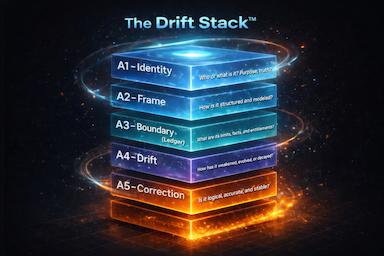
The Drift Stack™
Identity → Frame → Boundary → Drift → Correction
What You Are Buying
A low-cost video course can deliver information at scale. This is deliberately different: live instruction, your real problem, direct questioning, changing conditions, and a competency decision at the end.
No prerecorded course and no fixed classroom sequence. The work happens live and adapts to what you already understand and what you actually need to decide.
Work directly with the architecture developed across 150+ published articles and papers, two books, technical specifications, demonstrations, patent filings, and working systems.
Bring the AI initiative, architecture, vendor proposal, system diagram, governance plan, product, or decision already sitting in front of you. We use it.
Authority changes. Evidence becomes stale. Scope changes. Identity changes. Operating state changes. You must explain what happens next and why.
Learn to separate the model from the system around it and reason about identity, state, evidence, authority, drift, correction, admissibility, governance, and execution.
If you demonstrate the required competence, you earn Samirac Executive AI Architecture Certification. Attendance or payment alone does not create the credential.
You do not buy the certification. You buy the private instruction and examination. The credential is issued only if you demonstrate the required competence.
A video can explain what an execution boundary is. A multiple-choice exam can test whether you remember the definition.
Neither can stop you halfway through an answer and ask what changed, what state you are relying on, whether authority is still current, why the evidence is still valid, or whether you would still allow the action to execute.
The difference is not more content. The difference is whether you can still reason correctly when the conditions underneath the decision move.
Your Five Hours
There is no fixed classroom curriculum you must sit through before we get to your problem. If you need the fundamentals, we start there. If you already understand them, we go deeper. If you have an actual system, proposal, diagram, vendor, or decision in front of you, bring it.
Separate the model from the surrounding system so you can see the data, identity, memory, tools, workflows, people, authority, integrations, and external actions that determine how the system actually behaves.
Understand the difference between generating an answer, recommending an action, approving an action, and actually changing external state.
Examine what can change between intention and execution: state, identity, evidence, authority, objectives, context, counterparties, policy, and the operating environment.
Bring the proposal, architecture, platform, internal initiative, or vendor claim. We will work through what is being asserted, what is missing, and what leadership should understand before approving it.
Work backward from the result you actually need. Sometimes the answer is automation. Sometimes it is assistance, redesign, removal of unnecessary work, or deciding not to build something at all.
You do not need to become an AI engineer. You do need enough structural understanding to recognize when an explanation makes sense, when it does not, and when an unresolved question matters.
Live Competency Examination
The examination uses real or realistic systems and changing-state scenarios. The standard is not perfect vocabulary. The standard is whether you can reason through the structure when material conditions change.
• What is the system actually doing?
• What state is being relied upon right now?
• Who or what has authority to act?
• What evidence makes the proposed action admissible?
• What changed between the earlier decision and the moment of execution?
• Where is the execution boundary and what can stop the action?
• What must happen when evidence, identity, authority, scope, or operating state changes?
A decision may have been reasonable at T1. If the counterparty, authority, evidence, identity, scope, policy, or operating state changes before execution, you must determine whether the action remains admissible at T2.
Certification is awarded when you demonstrate that capability. If you do not yet meet the standard, the credential is not issued merely because the hours were completed.
The Body of Work Behind the Five Hours
A documented architectural corpus developed over time rather than a weekend collection of AI summaries.
The work includes a developed theory describing the collapse order of drift and the structural conditions required to preserve identity, reference, state, authority, and admissibility.
The architecture has been worked through in real software: persistent memory and identity in dAIsy, reusable state and memory architecture in Mind-Mesh, and agent-platform demonstrations in Scout.
The work includes the Samirac Execution Contract and demonstrated external interoperability with Gaia Nexus at the evidence and runtime-admissibility boundary.
You are not going to reproduce decades of technology, data, business, architecture, and implementation experience before your next executive meeting. You are not going to independently reconstruct the architecture, build the systems, test the theory, produce the demonstrations, and then return to the decision.
The certification compresses that accumulated work into a private applied learning and examination process directed at the problems you actually face.
Use the five hours in one concentrated day, several working sessions, or separate hours. The instruction can flex. The competency standard does not.
Stay inside the problem and work through the architecture and examination in depth.
Absorb the material, review your own systems, return with better questions, and continue from where we left off.
Use one hour at a time when that fits your schedule or lets the learning develop alongside real decisions.
One executive is included. An additional executive from the same organization may participate for $500. The credential remains individual: each person seeking certification must demonstrate the required competence.
You can ask an AI what an execution boundary is. You can read papers, download open-source software, watch presentations, and collect architecture diagrams. None of that tells you whether the system your company is about to build is the right system, whether the authority model is sound, whether a vendor claim survives inspection, or whether the problem should be solved differently in the first place.
The information may be available. The value is knowing what applies to the particular problem in front of you — and being able to defend that reasoning when the state changes.
Executive Certification
$1,500
One executive included · $500 each additional same-company participant
Payment is required before certification sessions are scheduled. If your organization requires an invoice for approval, an invoice can be provided; session time is reserved after payment is received.
You are purchasing the private instruction, application work, and examination process.
The credential is issued only after you demonstrate the required architectural reasoning under live examination.
That distinction is the value of the certification. Someone verifying the credential should know that Samirac actually examined the person behind it.
The separate Private Executive AI Architecture Briefing remains available as a five-hour private engagement for leaders who need direct answers, architecture work, and decision support without pursuing certification.
View the Private Executive Briefing →Private · Live · Applied · Examined
Five hours gives us enough room to establish the architecture, apply it to the decisions in front of you, change the conditions, and determine whether you can still reason correctly about what should happen next.
Five private hours · $1,500 · Certification earned through demonstrated competence